


Physical technology for moisture control in porous materials
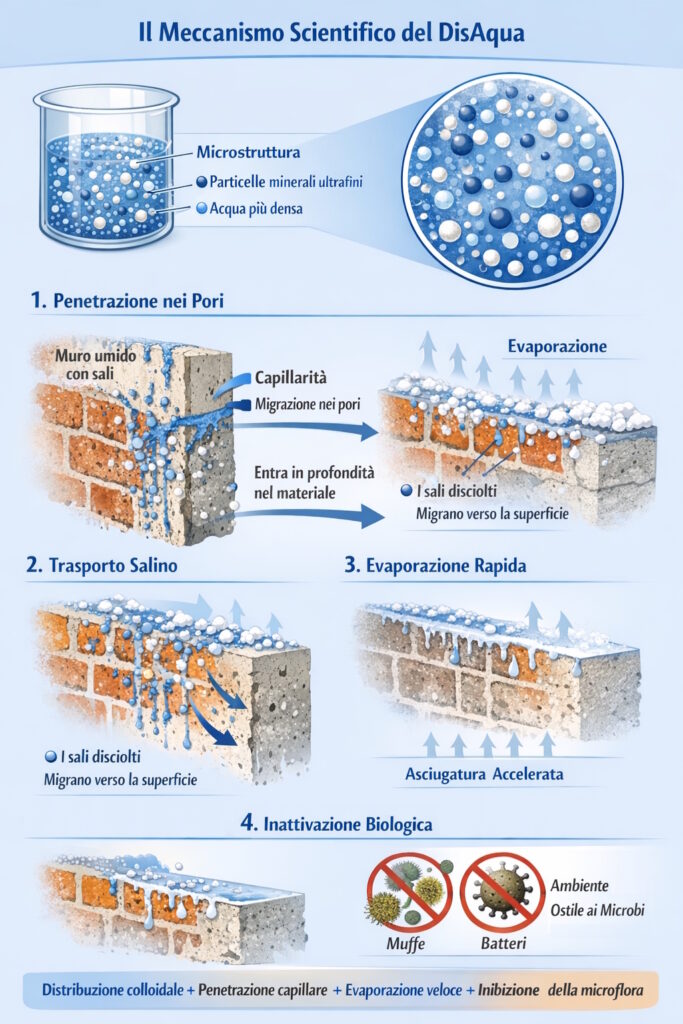
disAqua® – a technological platform based on purified water and an inert mineral colloidal suspension for managing moisture phenomena in masonry systems.
A non-reactive, biocide-free approach focused on understanding and modulating physical processes in porous materials.
Scientific framework of the phenomenon: moisture in walls
Moisture in walls is a complex phenomenon involving transport dynamics in porous materials, including:
- Capillary rise of water
- Migration of saline solutions
- Interactions between the porous structure and the external environment
The presence of water within building materials can affect:
- Physical stability of masonry
- Hygroscopic behavior of salts
- Progressive deterioration of finishes
In particular, dissolved salts (chlorides, sulfates, nitrates) play a key role in the deterioration processes of materials.
disAqua® technological approach
disAqua® operates in the field of advanced physical technologies applied to porous materials.
The system is based on:
- Highly purified water
- Colloidal suspension of inert mineral particles
The following are not used:
- Biocides
- Reactive chemical agents
- Functionalized polymers or resins
The approach is not based on direct chemical reactions, but on physical interaction with transport phenomena within the materials.
Physical principles of interaction in porous materials
The interaction between the system and the porous matrix occurs through well-established physical phenomena:
Capillary transport
Movement of fluids within the porous network driven by capillary forces.
Distribution in the micropores
The presence of the colloidal phase alters the diffusion dynamics within the material’s microstructure.
Salt solubilization dynamics
Salts present in materials can undergo processes of dissolution and subsequent migration.
Evaporative processes
Moisture redistribution promotes the formation of gradients that facilitate mass transfer toward the exterior.
Structure of the fluid system
The system consists of a combination of:
- Highly purified water
- Stable mineral colloidal phase
The presence of the colloidal phase can influence certain physical properties of the fluid, including:
- Wettability behavior
- Surface tension
- Interaction with heterogeneous porous materials
These parameters are relevant in transport processes within capillary systems.
Effects on masonry systems
The interaction between the technology and the materials can contribute to:
- Modification of moisture distribution dynamics
- Progressive reduction of water content in the pores
- Variation of internal hygrometric conditions
These effects develop over time and are linked to the natural rebalancing processes of the material-environment system.
Moisture in walls and microbiological phenomena
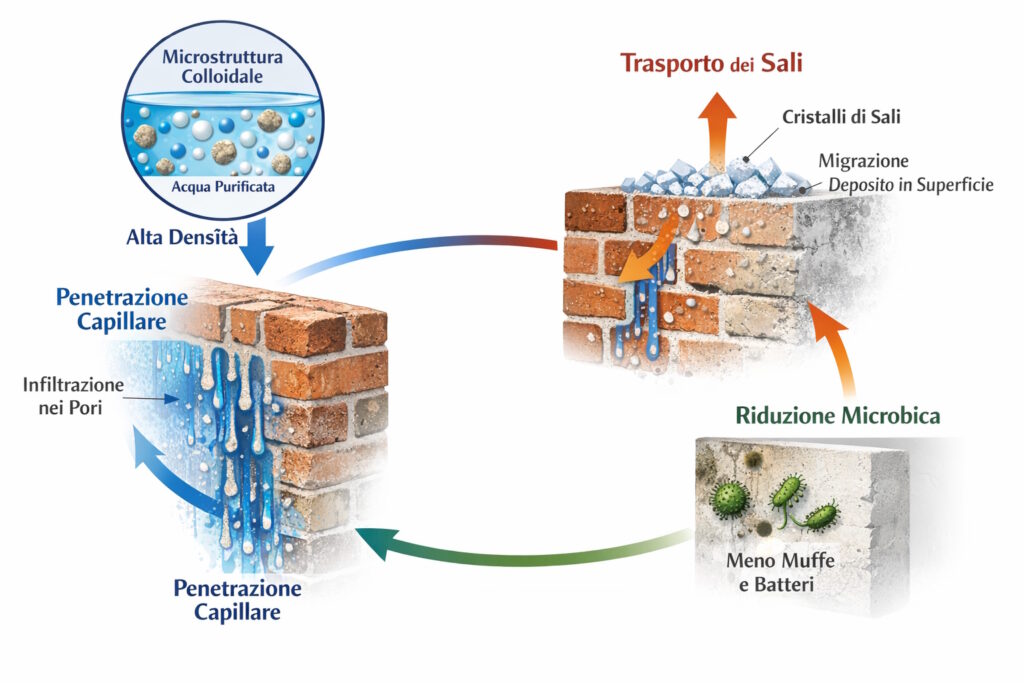
The presence of moisture in materials creates a favorable condition for the development of microorganisms, as it affects the water activity of the system.
The reduction of available water in the pores leads to:
- Decrease in conditions favorable to microbial growth
- Reduction of secondary biological activity
Scientific note:
disAqua® is not a biocidal system and does not act directly on microorganisms.
The observable effect is related to the modification of the physical conditions that allow their development.
Analytical evidence
In studies on treated and subsequently stabilized materials, chemical and bacteriological analyses can reveal:
- Reduction of detectable biological load
- Surface conditions compatible with the absence of active contamination
These results depend on:
- Initial state of the material
- Environmental conditions
- Degree of achieved hygrometric equilibrium
Technological scope and potential applications
The technology is relevant in contexts such as:
- Porous building materials
- Historic and contemporary construction
- Surfaces subject to persistent moisture phenomena
The main interest lies in the possibility of acting on the physical processes underlying moisture in materials.
Scientific positioning
disAqua® falls within the field of technologies:
- Physical technologies applied to porous materials
- Non-invasive
- Chemically non-reactive
- Oriented toward the sustainability of building systems
The approach focuses on controlling transport phenomena rather than on chemical modifications of the material.
Summary
The disAqua® technology represents a system based on:
- Physical interaction with porous materials
- Modulation of moisture transport phenomena
- Non-chemical approach to moisture control in walls
The objective is to promote stable hygrometric equilibrium conditions in building systems.
Concluding note
The content describes the physical principles and technological positioning of the disAqua® platform in both scientific and educational contexts.
Practical applications and operational procedures are addressed in dedicated technical venues.


