TEAS®: Electromagnetic Activation of Water and Impulsive Conversion in a Closed Cycle
Overview
TEAS Technology (Spectral Harmonic Electrolysis Technology) represents a research and development platform that addresses the energy conversion of water through an integrated approach combining applied physics, electromagnetism, and fluid dynamics.
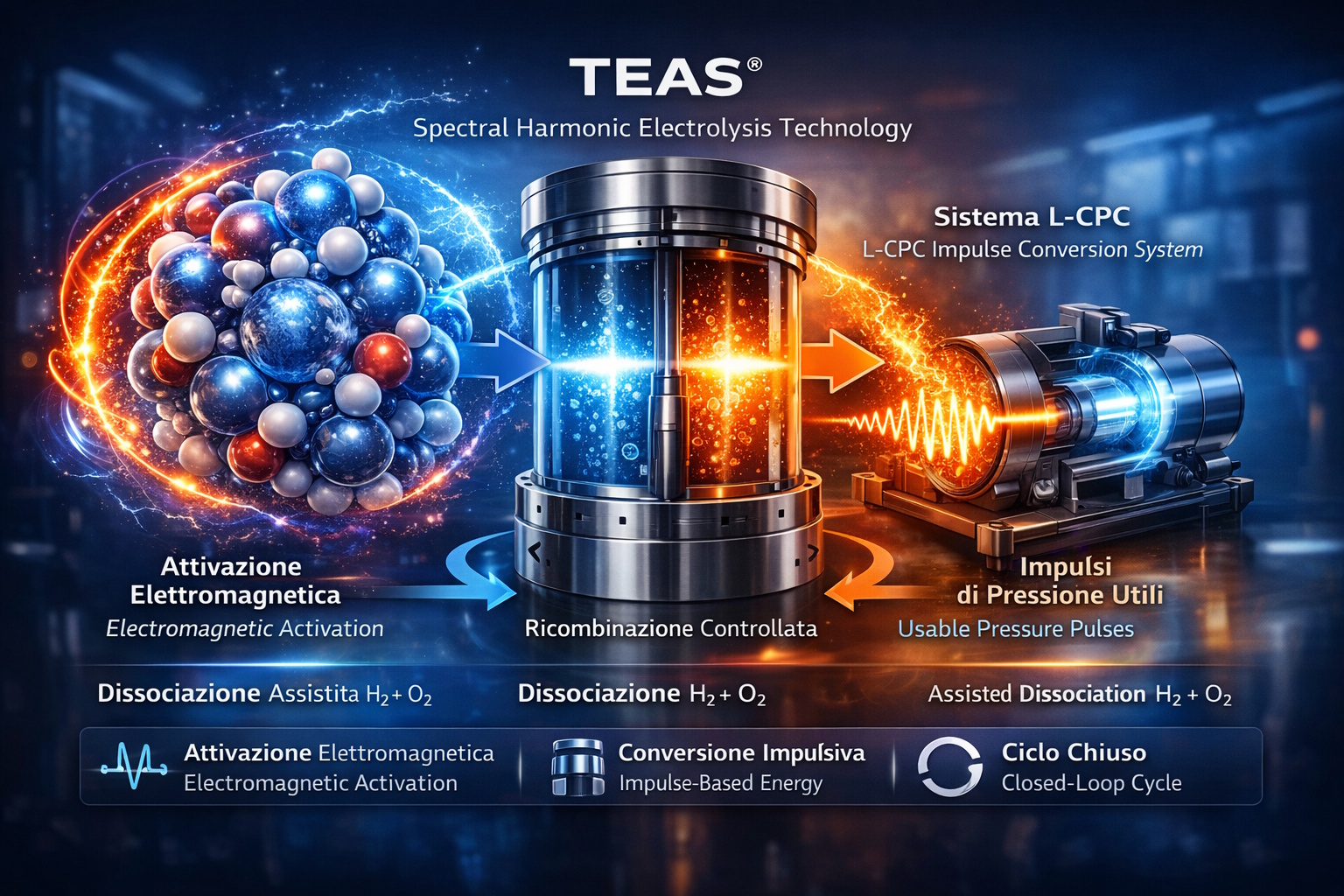
Within the TEAS architecture, the L-CPC (Liquid-Coupled Pressure Converter) module plays a key role as the interface between the chemical-energetic phase and the electromechanical phase, enabling the transformation of the released energy into controlled pressure impulses.
This page describes the L-CPC impulsive conversion technology, positioning it as a structural element of the TEAS platform.
Reference Technological Principle
Unlike conventional approaches, TEAS considers water not as a simple source of hydrogen, but as a dynamic H–O–H molecular system characterized by transient configurations and internal energetic interactions.
The system operates according to a separated functional sequence:
- Electromagnetic activation of water through controlled multifrequency fields
- Assisted dissociation, aimed at reducing process irreversibilities
- Controlled recombination in a closed, air-free environment
- Conversion of released energy into pressure impulses
The analyzed energy potential pertains to the entire H–O–H system and its dynamic transitions, not just the isolated hydrogen.
The Role of L-CPC Impulsive Conversion
The Liquid-Coupled Pressure Converter (L-CPC) is designed to:
- receive the energy released during controlled recombination,
- convert it into alternating pressure impulses,
- transfer the energy to a working fluid,
- generate controlled motion of a liquid piston,
- power a high-efficiency linear generator.
The impulsive chambers operate alternately, ensuring continuous fluid motion, reduced mechanical stress, and greater operational stability.
This functional separation allows for a clear distinction between:
- the chemical-energetic phase,
- the fluid-inertial phase,
- the electromechanical phase.
Efficiency and Energy Balance (Theoretical Scenario)
For illustrative purposes, assuming as a reference the theoretical energy content associated with complete recombination:
- 1 kg of water → 14.3 kWh (theoretical chemical energy H₂–O₂ → H₂O)
With a hypothetical overall efficiency of the TEAS + L-CPC system on the order of 50–60%, the theoretical electrical output would be:
- ≈ 7,1 kWh/kg (50%)
- ≈ 8,6 kWh/kg (60%)
These values represent the portion of chemical energy convertible into electricity after losses due to thermal, fluid-dynamic, and electromechanical dissipation.
The values indicated are for illustrative purposes only and do not constitute certified performance data.
Compliance with Physical Principles
The TEAS system with L-CPC impulsive conversion:
- requires initial activation energy,
- respects the overall energy balance,
- does not generate energy from nothing,
- does not violate the second law of thermodynamics.
Any potential energy advantage arises from the reduction of process irreversibilities and the optimization of the conversion phases.
Relation to Energy Applications
The L-CPC impulsive conversion technology serves as the technological bridge between the TEAS platform and its applications in the field of:
- closed-cycle electricity generation,
- distributed and off-grid power generation,
- low-emission, programmable energy systems.
Applications are covered in the sections dedicated to the Energy Transition.
Development Status
The TEAS technology with L-CPC module is currently:
- in an advanced development stage,
- supported by coherent theoretical models,
- subject to internal experimental testing,
- currently under patent protection.
Independent validations represent the next phases of the industrial development pathway.
Summary
L-CPC impulsive conversion represents the key element that enables the TEAS platform to transform the energy associated with water’s molecular transitions into mechanical and electrical work within a closed, controlled, and emission-free system.
It is an engineering research and development pathway that requires scientific rigor, progressive experimentation, and industrial consolidation.