Energy Transition and Technological Innovation
A Fundamental Goal for a Sustainable Future
Today, the energy transition represents a global priority with political, economic, and social implications. It involves the shift from high-carbon energy sources to low-emission, renewable, and sustainable sources, fitting into a broader and systemic vision of sustainable development and energy efficiency.
This path is based on two fundamental pillars:
- the gradual elimination of fossil fuels
- the continuous improvement of efficiency in energy production and consumption
Alongside established renewable sources – such as photovoltaic, wind, solar, and geothermal – the energy transition also requires new technological solutions capable of rethinking traditional models of energy generation, distribution, and use.
The process does not progress uniformly on a global scale. Some countries, particularly in Northern Europe, have already reached advanced levels of sustainability thanks to the availability of renewable resources and a strong environmental culture. Other regions are still in the early stages, making flexible, scalable, and adaptable technologies necessary.
The European Framework: Investments and Climate Regulations
The European Union has taken a leading role in the fight against climate change. With the Next Generation EU plan, substantial investments have been planned for the energy transition, allocating significant resources to energy efficiency, renewable energy, and distribution infrastructure, with the aim of achieving climate neutrality by 2050.
The European Climate Law makes it legally binding to reduce greenhouse gas emissions by at least 55% by 2030. The “Fit for 55” legislative package fits into this context, introducing concrete tools to align industrial, environmental and energy policies with European climate objectives.
Among the main elements of the package:
- social equity in the energy transition
- support for innovation and industrial competitiveness
- strengthening European leadership in environmental policies
- development of alternative fuels and new energy technologies
It is in this context that TEAS®’s commitment takes place Think Green Technologies.

Innovation in Sustainable Electricity Production
TEAS® Think Green Technologies R&D develops advanced technological solutions for sustainable electricity production, focused on energy independence and reducing environmental impact.
TEAS® technology allows a technical liquid derived from water to be transformed into a gaseous form that can be used to power generators, demonstrating the possibility of producing electricity in a completely green way and independently from the traditional grid.
This vision is realized in the development of the HG4HOME prototype, designed as a first step towards the creation of a station for energy independence, capable of integrating production, conversion, and energy management into a single modular system.
ENERGY SECTOR
HG4HOME Technology
Experimental Modular System
HG4HOME is an experimental modular plant designed as a platform for studying, validating, and optimizing TEAS® technologies.
The system allows:
- advanced instrumental measurements
- material durability and wear test
- performance simulations
- long-term reliability assessments
The system currently uses components that are easily available on the market, for demonstration and functional testing purposes. This choice allows the effectiveness of the technology to be illustrated in a concrete way, while being aware that the full potential can only be realized with solutions specifically designed for the final industrial-scale application.
TEAS® FORM
Advanced Water Treatment
The TEAS® Module It is an experimental unit dedicated to the advanced treatment of water, aimed at producing a fluid with controlled physicochemical characteristics, called Technical Liquid.
The system combines:
- electromagnetic fields at a defined frequency
- low-intensity electrochemical processes
- geometric configurations and specific confinement conditions
The action of the module reproducibly affects the molecular and supramolecular dynamics of water, reversibly altering parameters such as:
- Distribution of hydrogen bonds
- ionic conductivity
- behavior of molecular clusters
No irreversible chemical transformations occur in the H₂O molecule. The induced effects are physical and organizational in nature and can be measured using standard characterization techniques, including conductometry, dielectric spectroscopy, impedance measurements, thermal analysis, and NMR.

In the HG4HOME system, the TEAS® Module is designed to optimize the electrochemical and thermodynamic response of the fluid in subsequent stages, such as electrolysis, gas generation, and experimental energy conversion. The module is conceived as a standalone unit, suitable for continuous operation and integration into modular research and development systems.
Pilot Plant and Modular Architecture
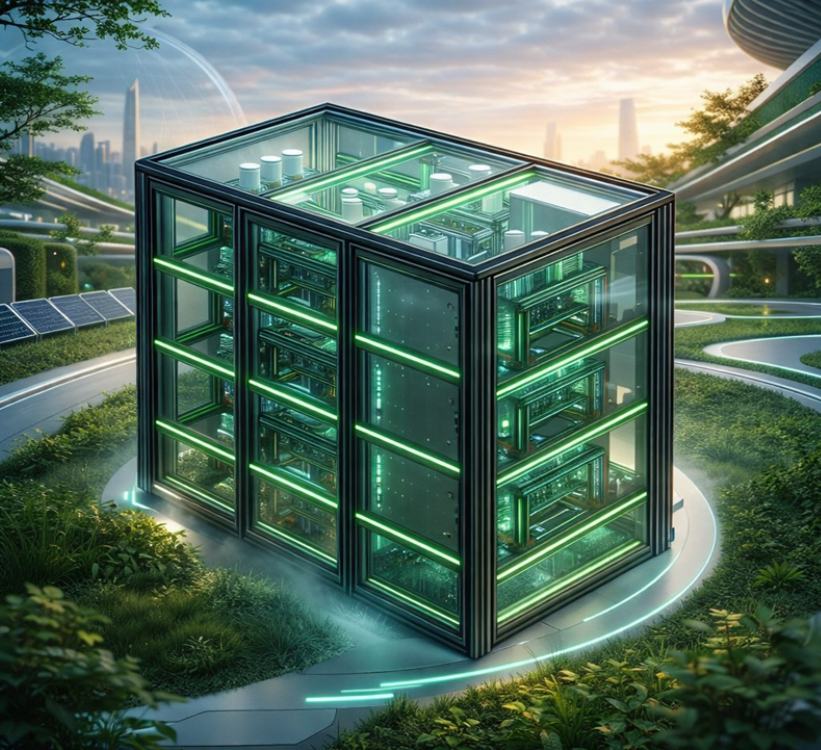
The TEAS® pilot plant consists of independent and reconfigurable modules, designed for advanced experimental studies.
Block 1 – Advanced Support and Electrolysis
Structure dedicated to housing TEAS® electrolyzer modules, integrated with servo controls, actuators, and PLC for full system control.
The PLC allows for precise management of operational parameters, monitoring of energy performance, and modulation of the gases produced during the advanced electrolysis process.

Block 2 – Conversion into Gaseous Variant
Facility dedicated to the transformation of Technical Liquid into different gaseous variants, allowing the generation of various TRI-GAS configurations based on application requirements.

Block 3 – Energy Management
Module containing an inverter, storage batteries, measurement instruments, and resistive loads. The energy produced is managed, stored, and used to simulate real operating conditions.

Energy Generation and Current Limits
In the representative model, Otto cycle gasoline generators are used, chosen for their reliability and availability. The gas produced by the TEAS® system is treated and made compatible with these units, allowing for functional validation of the process.
The main limitation of this configuration is related to the theoretical efficiency of internal combustion engines, constrained by the Carnot principle, which imposes a maximum efficiency of around 50%.

NEW ENGINE-GENERATOR
New Motor-Generator and L-CPC-TEAS® Technology
Towards the Final Model
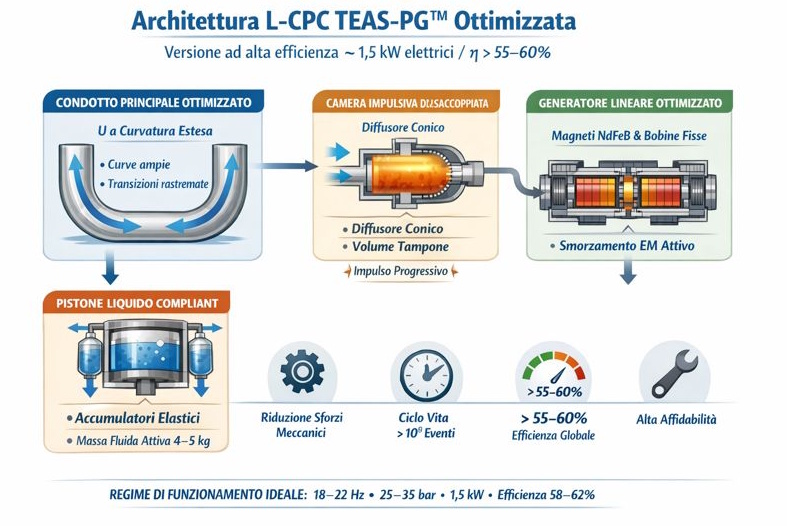
TEAS Think Green Technologies is developing a new dedicated motor-generator, based on the proprietary L-CPC-TEAS® (Linear Controlled Pressure Converter) technology.
This solution introduces a new paradigm in energy generation, converting controlled pressure pulses directly into electricity through a bidirectional alternating linear motion, eliminating traditional rotating components prone to wear.
The engine is designed with a project efficiency of 60%, significantly higher than conventional solutions, with further potential for optimization.
The main advantages include:
- reduction of mechanical losses
- greater stability and control precision
- lower structural complexity
- greater reliability and reduced maintenance
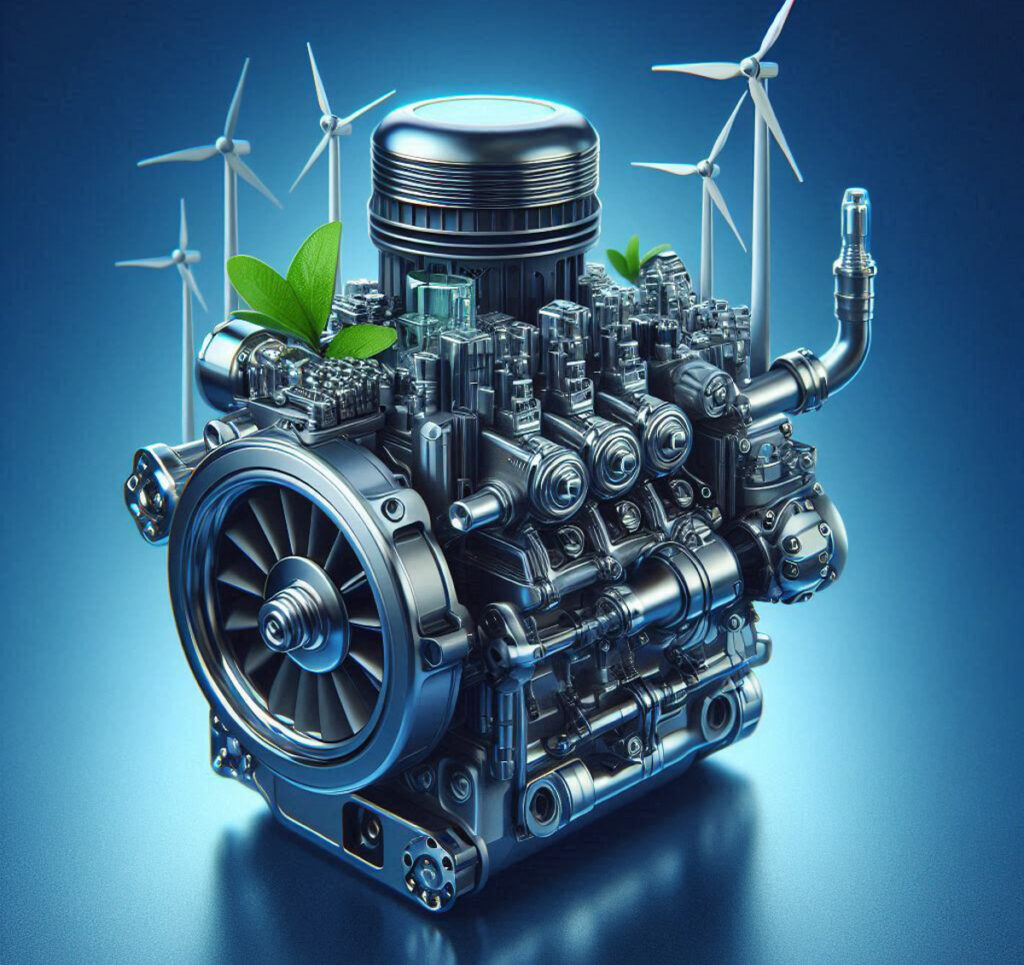
The integration of L-CPC-TEAS® technology represents the natural evolution of the HG4HOME project towards a definitive, scalable, and sustainable platform designed for industrial, experimental, and advanced energy production applications.
More information: L-CPC-TEAS®