
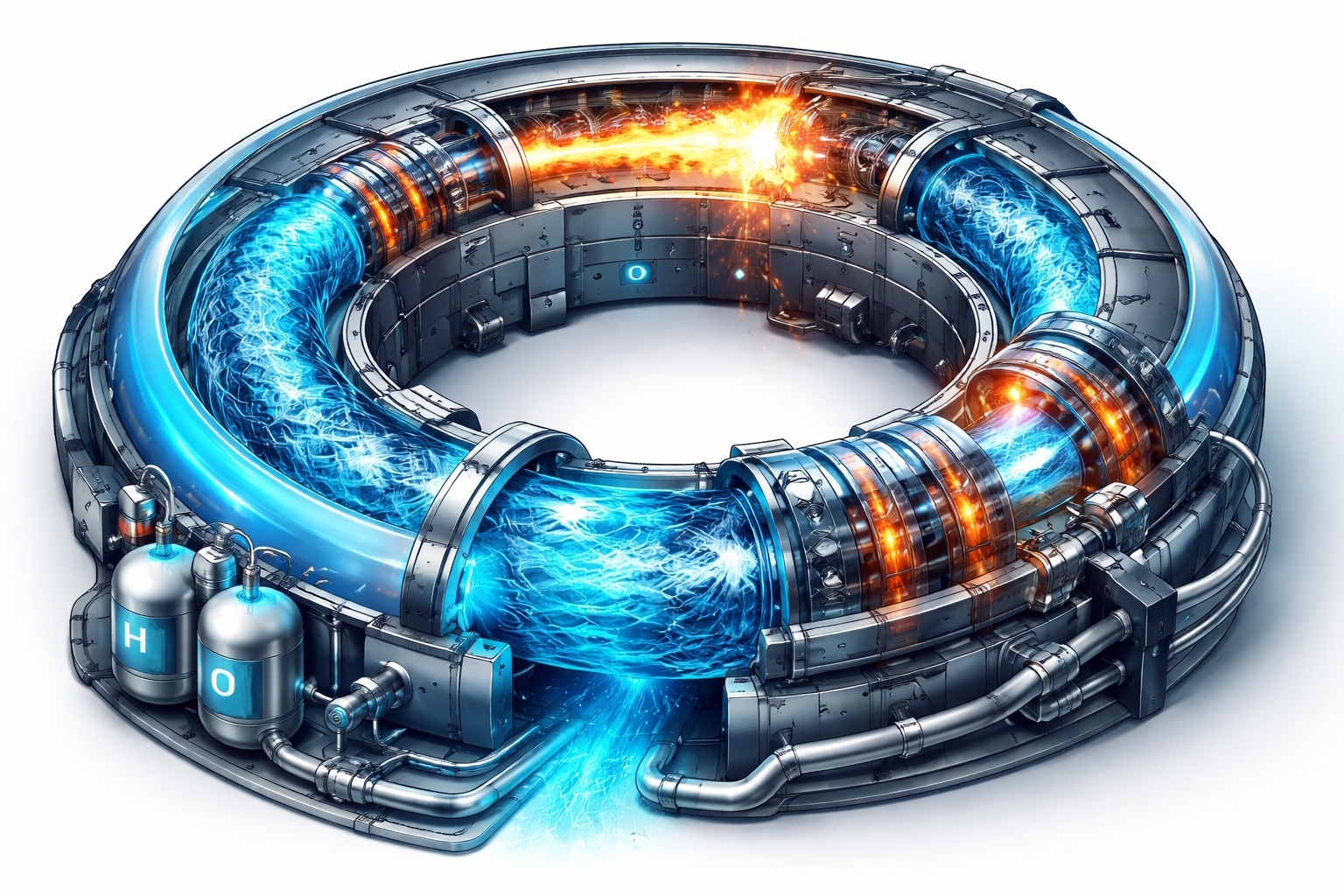
Closed-cycle motor generator with liquid piston in L.T.
Foreword
The closed-cycle motor generator with liquid piston in L.T. is a system currently in the Research & Development (R&D) phase.
It is an experimental technological platform designed to validate an innovative energy conversion architecture based on:
- controlled pulsed combustion in a closed cycle
- toroidal liquid piston
- use of Technical Liquids (L.T.) derived from structured water
- integration of thermodynamics, fluid dynamics, and electromagnetic control
The indicated performance levels and parameters represent design objectives and theoretical benchmarks currently under study, subject to experimental validation and engineering optimization.
The project falls within advanced development activities aimed at exploring new solutions for high-density, high-efficiency energy generation.
R&D Innovation in Pulsed Energy Conversion
Our closed-cycle motor generator uses a toroidal liquid piston architecture, in which the working fluid is an L.T. – Technical Liquid derived from structured water, developed using TEAS® technology.
The system is designed to convert high-density energy pulses (H₂/O₂) into continuous unidirectional motion, which is then transformed into electricity with high mechanical stability.
Operating Principle
- Closed-cycle H₂/O₂ combustion chamber
- Pulsed gas expansion
- Thrust on the L.T. fluid interface
- Continuous circulation in the toroidal loop
- Power extraction via electromechanical system
The motion is non-reciprocating: the absence of kinematic reversals reduces vibrations, mechanical losses, and structural complexity.
The strategic role of the L.T.
L.T.s are not simple liquids, but highly engineered fluids obtained through:
- modulation of electric and electromagnetic fields
- control of molecular cluster dynamics
- stabilization of structural properties under industrial conditions
In the generator, the L.T. simultaneously performs the functions of:
- frictionless fluid piston
- distributed inertial accumulator
- pressure wave damper
- natural dynamic seal
- power transmission medium
This integration of thermodynamic engineering and structural fluid control represents the core of the R&D innovation.
Technological Advantages
- Optimal management of high-pressure pulses
- Conversion from pulsed energy to continuous flow
- Reduction of local mechanical stresses
- High structural robustness
- Power-scalable architecture
The toroidal circuit acts as a natural hydraulic flywheel, stabilizing energy delivery.
Potential Performance
In advanced configurations, the architecture can achieve:
55–70% chemical-to-electric conversion (theoretical reference value)
The benefits arise from reduced mechanical losses and optimized pulsed dynamics.
Application areas
L.T.s developed with TEAS® technology can be adapted for:
- energy transfer systems
- advanced chemical processes
- fluid-inert applications
- high-pressure industrial environments
- compact high-energy-density generation platforms
R&D Vision
This platform integrates:
- closed H₂/O₂ cycle
- toroidal fluid dynamics
- electromagnetic control of the fluid
- high-efficiency thermodynamic design
The result is a compact, robust, and technologically distinctive generation system, developed for advanced industrial applications and high-specialization energy scenarios.

