
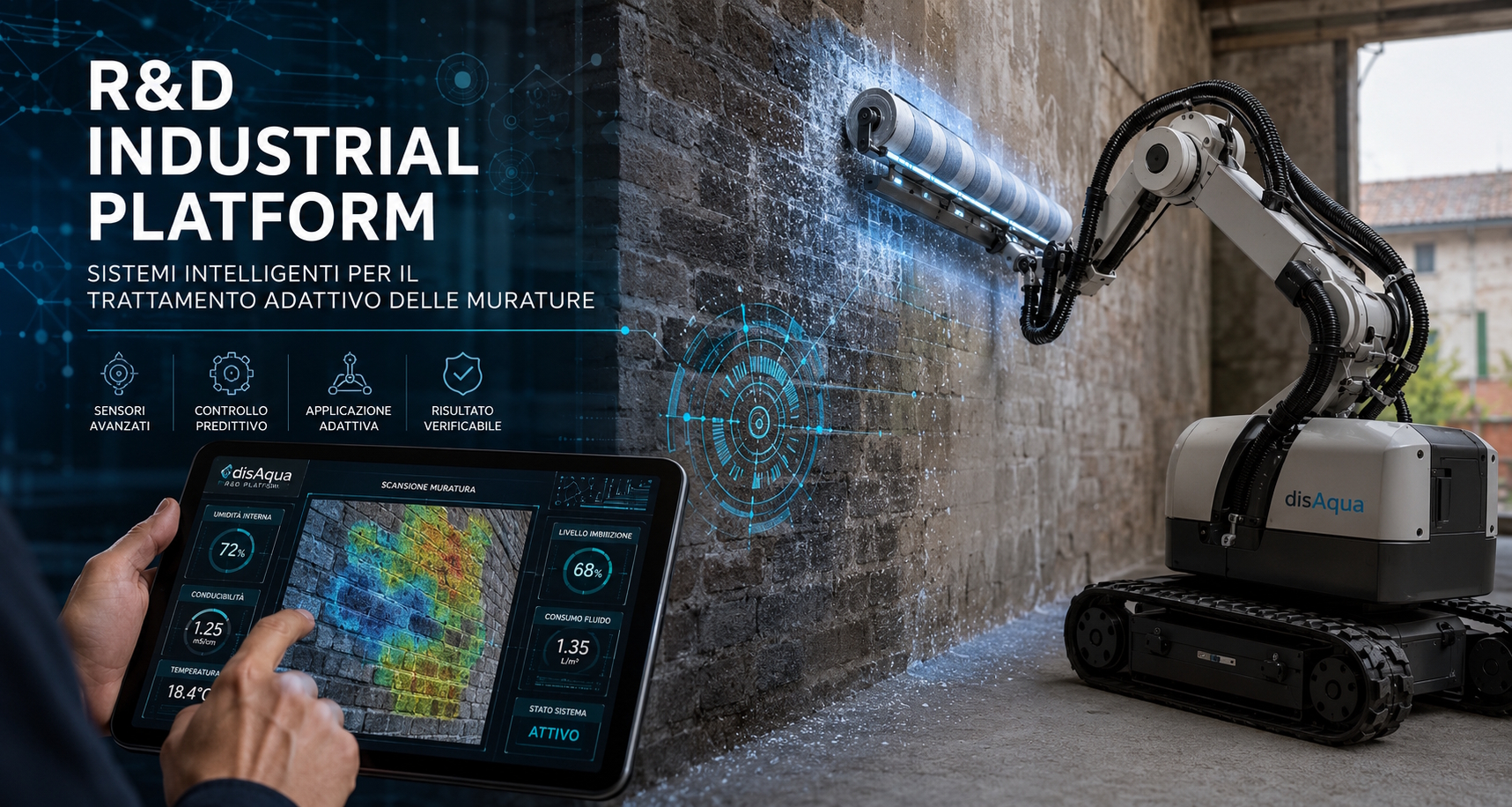
Application automation, predictive control, and treatment digitalization
Beyond manual application
In the treatment of damp masonry, the final result does not depend solely on the product used, but on the ability to achieve the correct level of saturation of the porous material.
This condition is not directly visible and is normally estimated by the operator during application.
Each masonry structure exhibits different behaviors depending on:
- internal porosity
- residual moisture content
- presence of salts
- material density
- Environmental conditions
For this reason, traditional treatments require experience, continuous attention, and constant assessment during the intervention.
The limitation of the human factor
During the treatment, the operator must continuously assess:
- amount of fluid to be delivered
- forward speed
- level of surface saturation
- signs of excess or insufficient saturation
- correct timing for stopping the treatment
These decisions may be influenced by:
- physical fatigue
- extended working times
- job site operational pressure
- variability of individual experience
Even when skilled operators are involved, the final result can therefore vary significantly and is not always easily reproducible.
Treatment efficiency and reduction of application error
The disAqua® system has already demonstrated effective application performance when the treatment is carried out under the correct operating conditions.
The technical result primarily depends on achieving the correct saturation of the porous material during the initial phase of application.
The critical variables do not concern the product formulation, but rather:
- quantity of fluid delivered
- application times
- uniformity of distribution
- actual level of substrate saturation
- correct timing for stopping the treatment
In manual applications, these parameters are managed directly by the operator and may vary depending on experience and operating conditions.
The introduction of automated systems instead makes it possible to:
- optimize application quantity and timing
- reduce operational variability
- limit human error
- standardize the achievement of the optimal saturation condition
This approach can help reduce operating times, application waste, and intervention costs, while maintaining uniformity and quality of the final result.
From empirical treatment to intelligent control
The disAqua® research was developed with the aim of transforming a traditionally empirical process into a system that is:
- controllable
- measurable
- adaptive
- replicable
Through the integration of:
- advanced sensors
- data processing systems
- physical models of porous materials
- automated application platforms
the platform can:
- continuously monitor the masonry
- analyze absorption behavior
- estimate the actual saturation level
- automatically adjust the treatment
- stop the delivery upon reaching the defined operating parameters
The system thus maintains constant control of the application process, reducing operational variability and improving the replicability of the treatment.
Digitization of the treatment
The objective of the disAqua® platform is to transform masonry treatment from a predominantly manual activity into a process that is:
- parameterized
- monitorable
- adaptive
- digitally verifiable
This approach makes it possible to:
- improve treatment uniformity
- optimize fluid consumption
- reduce application errors
- minimize losses and waste
- increase the replicability of results
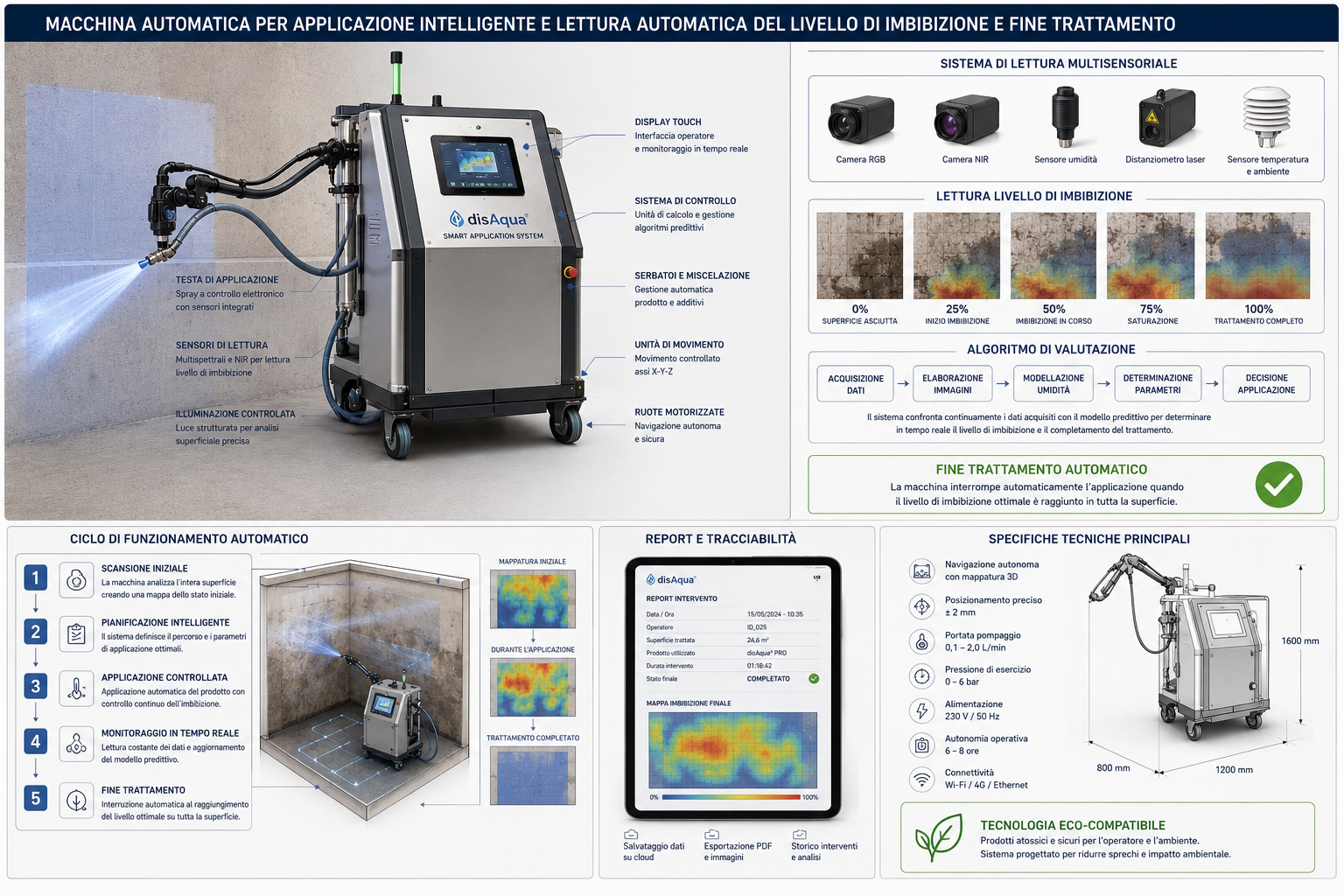
Technological architecture of the platform
The disAqua® R&D platform integrates different coordinated technological layers.
Advanced functional fluids
Formulations designed to:
- distribution within porous materials
- control of capillary dynamics
- compatibility with breathable substrates
- reduction of environmental impact
Diagnosis and monitoring systems
Technologies based on:
- RGB and multispectral imaging
- moisture sensors
- flow and pressure sensors
- digital surface analysis
- mapping of absorption
aimed at analyzing the condition of the masonry and the behavior of the treatment.
Predictive models and adaptive control
The platform can integrate:
- computer vision
- supervised machine learning
- physical models of porous materials
- predictive control systems
with the aim of estimating the evolution of saturation during application.
Automated application systems
The application machines can automatically adjust:
- fluid flow rate
- delivery pressure
- application speed
- local distribution of the treatment
based on real-time detected conditions.
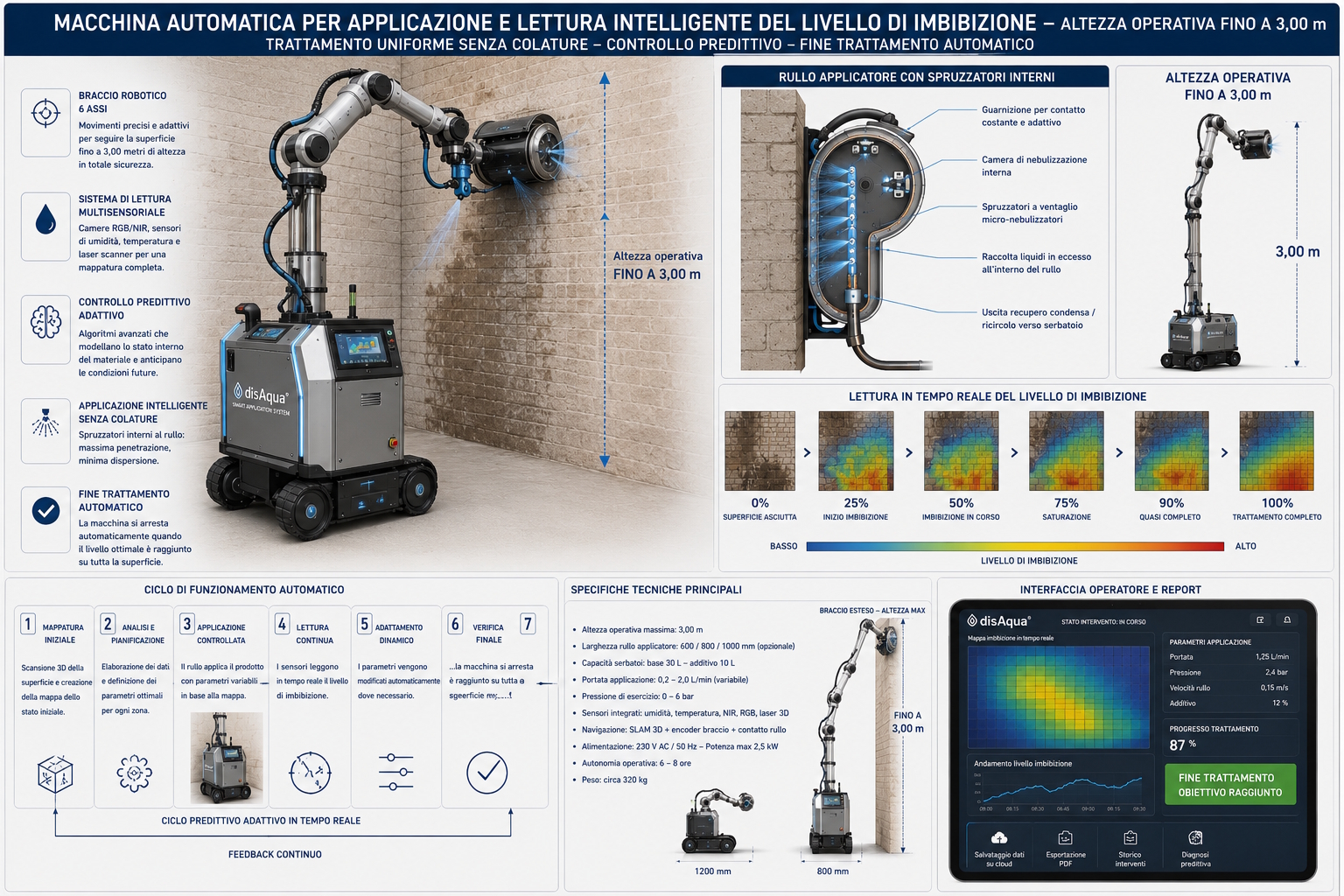
Application platforms
Research & Development activities include different operational configurations.
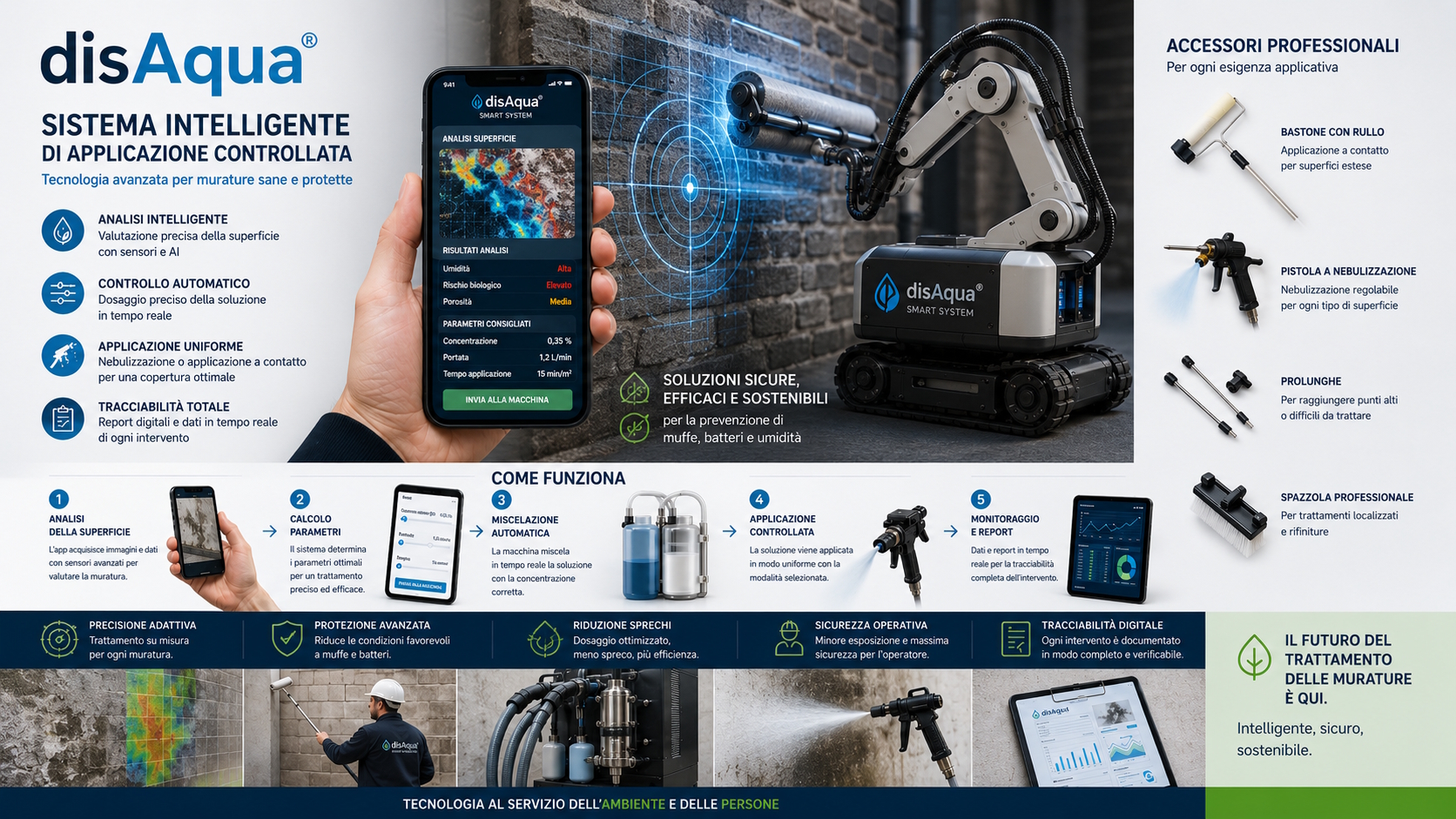
Professional portable system
Compact configuration intended for:
- localized applications
- professional maintenance
- small indoor interventions
It includes:
- smart pump
- controlled dosing
- app-based control management
- monitoring of operating parameters
Adaptive semi-automatic system
Version designed for:
- medium-sized surfaces
- uniform applications
- reduction of operational variability
The configuration can integrate:
- automatic flow rate regulation
- saturation sensors
- electronic pressure control
- continuous operational feedback
Intelligent automatic machine
Advanced system capable of:
- reading the masonry’s saturation level
- estimating the local saturation of the material
- automatically adjust the treatment
- stopping the application upon reaching the target operating conditions
The platform can integrate:
- multispectral imaging
- contact sensors
- predictive models
- closed-loop control
Smart roller with integrated nebulization
System designed for:
- reducing excess liquid
- limiting runoff
- improving application uniformity
The roller can integrate:
- internal micro-nebulizers
- controlled distribution chamber
- recovery of excess fluid
- surface contact sensors
Multi-axis robotic system
Advanced version developed for:
- large vertical surfaces
- industrial environments
- high-precision automation
The system may include:
- mobile platform
- multi-axis arm
- smart roller in contact with the wall
- continuous surface scanning
The sprayers integrated into the roller enable:
- controlled application at the point of contact
- reduction of free misting
- minimization of drips
data-driven evolution
The collection of application data enables:
- continuous improvement of operational models
- optimization of application parameters
- construction of technical application databases
- progressive increase in system precision
This approach enables the development of increasingly adaptive and controllable platforms over time.
Potential business models
The disAqua® industrial platform can evolve through different operational models:
- sale of professional machines
- operational leasing (Machine-as-a-Service)
- technology licensing
- digital services and application data management
The combination of application technology, automation, and data management opens up potential high-value industrial developments.
Sustainability and ESG positioning
The platform is designed according to criteria aimed at:
- reduction of environmental impact
- minimization of waste/dispersion
- optimization of consumption
- reduction of application waste
- compatibility with breathable materials
- enhanced operational safety
in line with an approach consistent with:
✔ sustainable construction
✔ green-tech innovation
✔ low-impact automation
✔ ESG strategies
Vision
disAqua® aims to develop an advanced platform for adaptive masonry treatment, capable of integrating:
- advanced functional materials
- application automation
- advanced sensor systems
- predictive control
- physical models of porous materials
with the aim of transforming the treatment of porous surfaces into a process:
- controllable
- measurable
- adaptive
- digitally verifiable
while reducing dependence on the operator’s subjective assessment and increasing uniformity, efficiency, and replicability of the application results.
Note
The configurations illustrated represent possible technological developments subject to research, development, and progressive validation activities.


