
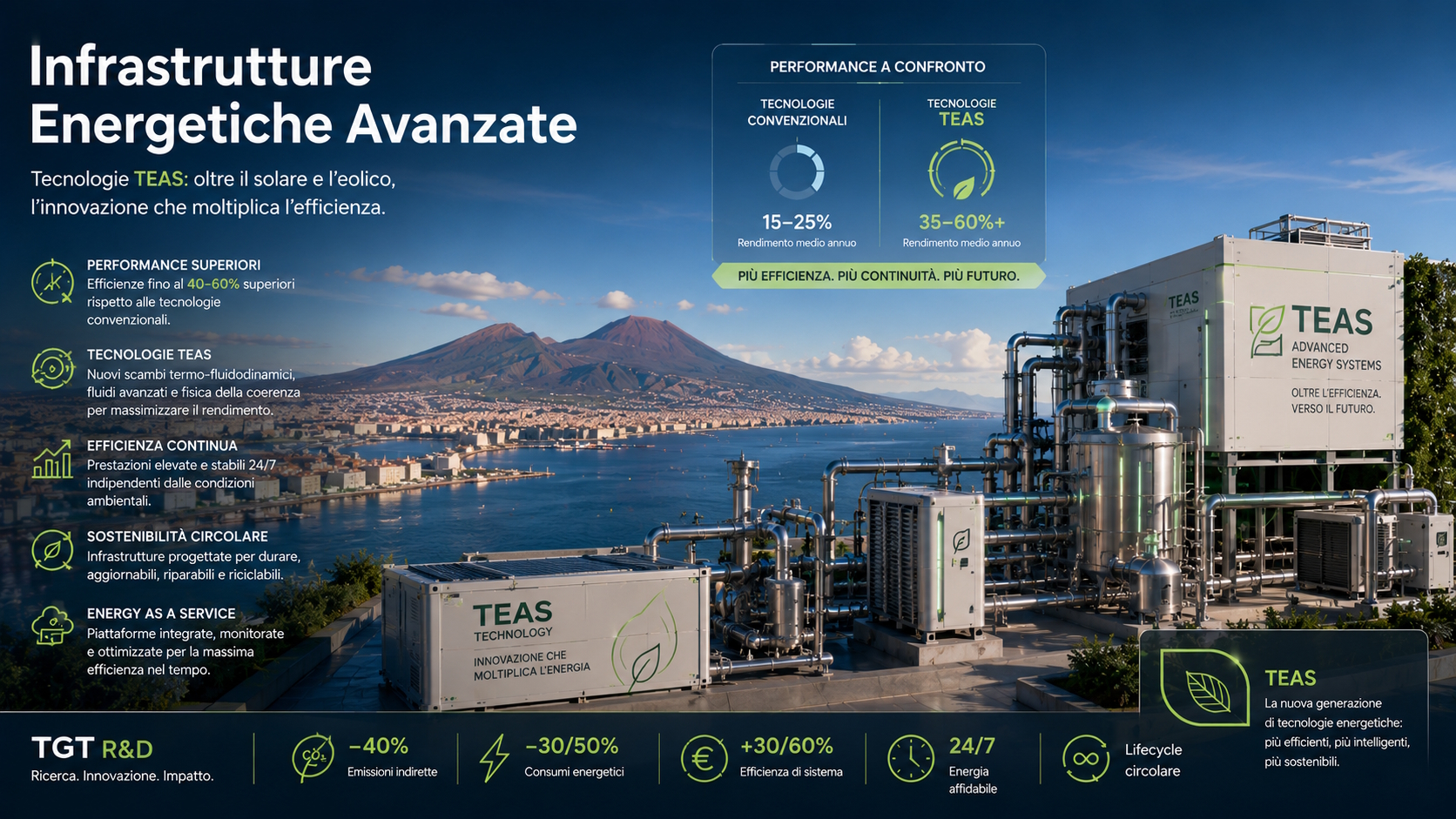
Research and Development on TEAS Technologies
For high-efficiency energy systems
TGT R&D develops advanced energy technologies and infrastructure by integrating applied research and industrial development aimed at enhancing the performance of energy systems, reducing losses, and optimizing environmental impact throughout the entire operational life cycle.
The approach combines thermo-fluid dynamics engineering, digitalization of energy systems, and advanced modeling, with the goal of contributing to the development of more efficient, integrated, and sustainable infrastructure.
The visual representations in the communication materials illustrate evolving scenarios and advanced infrastructural configurations of technologies under development and integration.
From Energy as a Product to Energy as a Service
The energy sector is evolving from a model based on isolated technologies toward integrated and time-managed infrastructures.
For years, the market has been based on separate systems:
- Energy production
- Energy storage
- Thermal management
- Digital monitoring
Today, the sector is evolving toward integrated energy platforms capable of continuously optimizing performance, consumption, and operational stability.
Energy is increasingly being viewed not merely as a technical product, but as a continuous operational service, monitored, updatable, and managed through data, automation, and intelligent system control.
The value lies not in the individual component, but in the overall efficiency of the integrated energy system.
TEAS Technologies and Applied Research
TGT R&D’s activities focus on the development of advanced energy technologies based on the TEAS Process, understood as an evolving technological framework for the integration and optimization of complex energy systems.
The main research areas include:
- Optimization of energy exchanges
- Advanced management of technical fluids
- reduction of losses
- improvement of operational stability
- integration of energy components
- digitalization and intelligent system control
The technologies are designed as enabling elements for the evolution of energy infrastructures, with assessments based on measurable KPIs, comparative simulations, and progressively validated experimental protocols.
Industrial applications and advanced energy systems
The developed technologies have potential applications in various contexts:
- integrated energy infrastructures
- complex industrial systems
- retrofit of existing plants
- high-efficiency HVAC systems
- advanced thermal equipment
- innovative energy devices
- energy solutions for civil and industrial sectors
- low-environmental-impact technologies
The goal is to promote a gradual transition toward more efficient, scalable systems that are compatible with existing infrastructures, contributing to the enhancement of energy performance and the reduction of indirect emissions.
Energy efficiency and environmental impact
The research is focused on improving the overall performance of energy systems through:
- reduction of losses in energy processes
- optimization of thermal and fluid-dynamic exchanges
- improvement of operational continuity
- reduction of auxiliary energy consumption
- containment of indirect emissions
- increase in systemic efficiency
Performance is analyzed through energy KPIs, comparative simulations, and progressively validated experimental protocols.
Circular economy and life cycle
Energy infrastructures are designed according to the principles of circular economy and lifecycle engineering.
The systems are designed to be:
- modular
- upgradable
- repairable
- disassemblable
- recoverable at end of life
This approach allows for reducing resource consumption, extending the useful life of infrastructures, and decreasing environmental impact throughout the entire operational life cycle.
Digitalization and intelligent systems
Advanced energy infrastructures integrate digital platforms for the intelligent management of operational performance.
These platforms enable:
- real-time monitoring
- predictive maintenance
- digital twin
- artificial intelligence applied to consumption
- energy system simulation
- performance traceability
The goal is to make systems progressively more adaptive, transparent, and optimized, promoting the integration of physical infrastructures with advanced digital management.
Retrofit and scalability
The developed technologies are designed to be applicable:
- in new energy infrastructures
- in the upgrade of existing plants
- in the optimization of complex industrial systems
This approach enables a gradual energy transition that is compatible with current infrastructures, reducing the costs of complete replacement and supporting the progressive evolution of systems.
Scientific validation and technological development
The development of advanced energy technologies requires a rigorous process of independent validation and performance measurability.
Verification activities include:
- comparative tests
- verifiable energy KPIs
- life cycle assessment (LCA)
- replicable experimental protocols
- collaboration with universities and research centers
- compliance with European regulations
- definition of TRL levels
Quantitative performance validation is a key element for ensuring the reliability, transparency, and industrial scalability of the technologies developed.
Towards new energy infrastructures
The energy infrastructures of the future progressively integrate energy, data, and automation into a single ecosystem:
- energy
- data
- automation
- maintenance
- sustainability
- operational management
This evolution aligns with the main European directives:
- decarbonization
- energy decentralization
- infrastructural resilience
- circular economy
- industrial digitalization
- resource efficiency
TGT R&D Vision
The TEAS Process represents an applied research line focused on the development of advanced energy technologies and integrated infrastructures.
The objective is to contribute to the evolution of energy systems toward greater efficiency, reliability, and sustainability through an integrated scientific, engineering, and digital approach, focused on the progressive validation of performance and the scalable industrialization of next-generation energy technologies.
Have Any Project?
Let’s talk and grow your business
We’re ready to help you. Our expert is here for you: send us a message

