
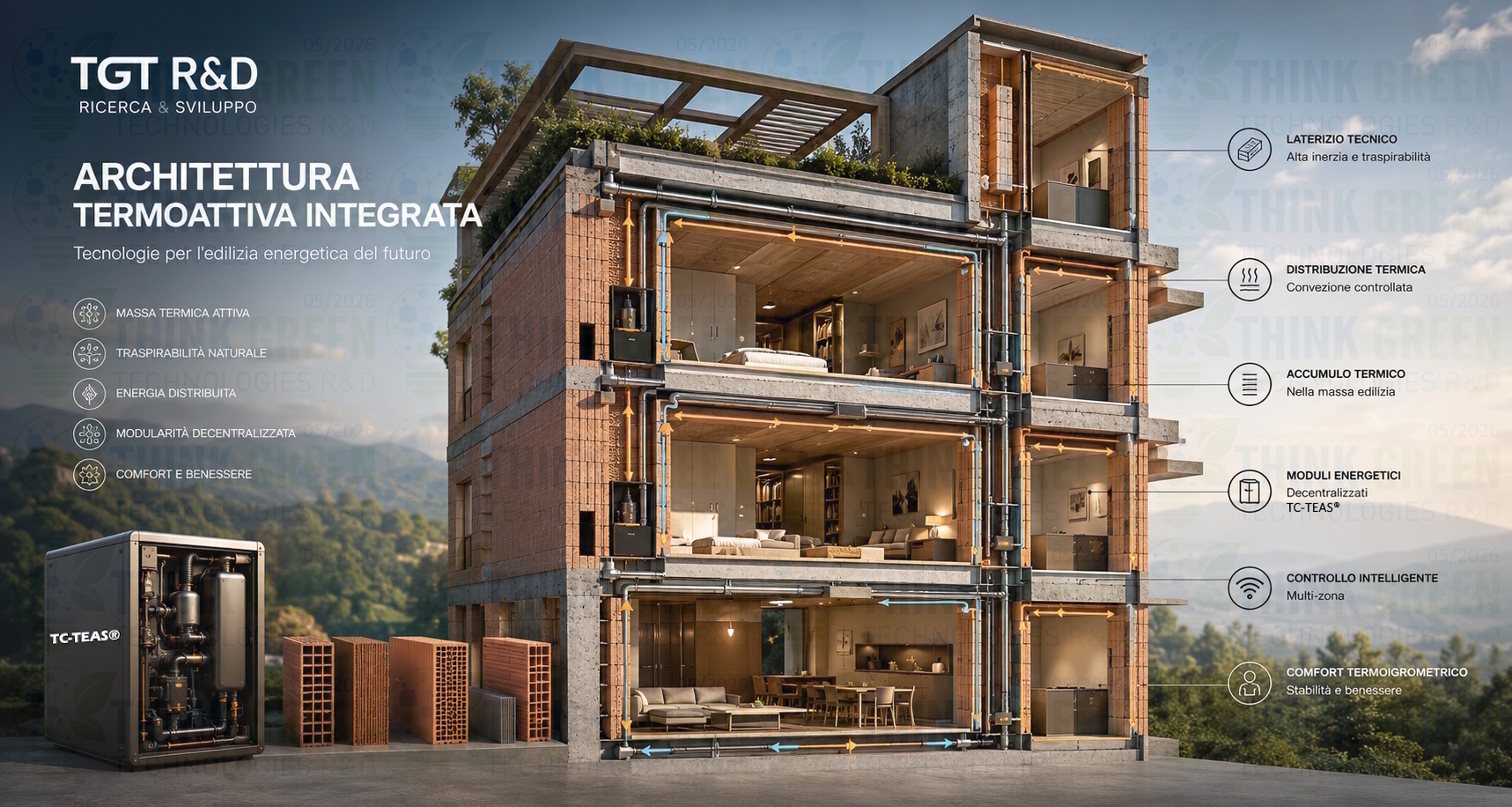
TGT R&D
New Technologies for the Energy-Efficient Buildings of the Future
Research & Development for a New Generation of High Thermal Mass Buildings
TGT R&D develops thermo-active building systems in which the architectural structure is no longer merely a passive envelope, but actively contributes to the building’s energy and thermo-hygrometric management.
The research activity integrates into a single technological platform:
- high thermal mass breathable technical brick,
- controlled convection-based energy distribution,
- distributed thermal storage within the building mass,
- decentralized energy modularity,
- intelligent thermo-hygrometric control,
- experimental TEAS® thermal generation systems.
The objective of the R&D program is to develop buildings designed to improve:
- occupant comfort,
- thermo-hygrometric stability,
- indoor environmental quality,
- systemic energy efficiency,
- integration between architecture, matter, and energy.
The Building as a Dynamic Energy System
Occupied environments are systems subject to continuous exchanges:
- thermal,
- hygrometric,
- energy,
- environmental.
Human presence, daily water usage, natural ventilation, and climatic variations continuously alter the internal conditions of the building.
For this reason, TGT R&D places particular emphasis on:
thermal inertia, wall breathability, and environmental balance.
A building envelope designed to work in synergy with these dynamics can help to:
- improve thermo-hygrometric stability,
- reduce surface condensation phenomena,
- limit stagnation and stratification,
- promote thermal uniformity and perceived comfort,
- reduce dependence on invasive environmental control systems.
The research therefore considers the building not as a static container isolated from the environment, but as an inhabited system capable of dynamically interacting with energy, air, humidity, and thermal mass.
Brick as an Advanced Thermo-Hygrometric Technology
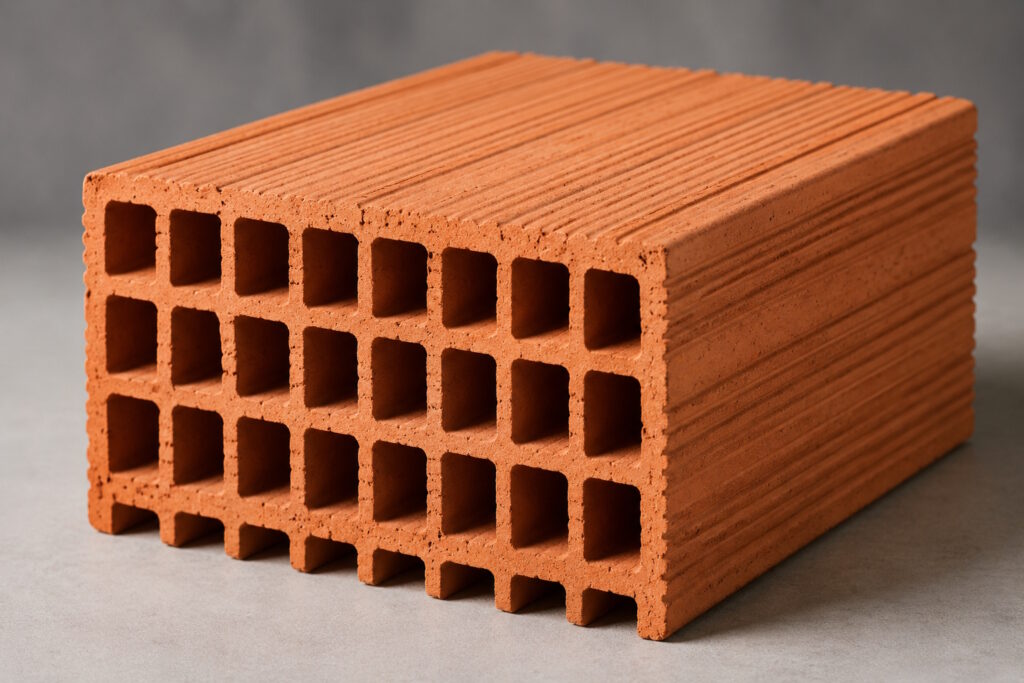
Brick represents one of the most established construction technologies in the history of architecture for:
- durability,
- thermal inertia,
- structural stability,
- natural breathability,
- hygrometric balance.
As early as the architecture of the ancient Roman Empire, the properties of brick were exploited for their ability to create stable, durable, and climatically balanced buildings.
TGT R&D reinterprets these construction principles in a contemporary key through integrated thermo-active building systems with high distributed energy inertia.
Brick thus evolves from a simple construction material into an active component of the building’s energy regulation.
The physical and mineral properties of the brick mass in fact allow it to:
- store thermal energy,
- stabilize environmental variations,
- promote wall breathability,
- contribute to the gradual distribution of heat,
- improve long-term living comfort over time.
A New Construction Paradigm
NIn conventional construction:
- the building structure primarily serves a static and separating function;
- energy systems operate as independent systems layered onto the building.
TGT R&D research instead explores a model in which:
the building structure and energy operate as a single integrated system.
Walls, technical cavities, and structural volumes are designed to:
- distribute thermal energy,
- store and stabilize heat,
- promote gradual energy distribution,
- contribute to thermo-hygrometric balance,
- reduce localized energy concentrations.
The building mass is used as a distributed energy storage element integrated into the building’s thermal behavior.
The building thus evolves toward an integrated thermo-active configuration characterized by high energy inertia and widespread environmental stability.
Active Thermal Mass Technology
The experimental platform developed by TGT R&D is based on the interaction between:
- high thermal mass breathable brick,
- vertical cavities integrated into the structure,
- thermo-active technical chambers,
- controlled convective distribution,
- distributed modular energy units.
Energy is transferred through low-velocity tempered airflows, leveraging:
- thermal storage capacity of the building mass,
- controlled convection,
- gradual heat distribution,
- distributed energy stabilization.
Unlike high-energy-concentration systems, the distributed thermo-active approach aims to promote:
- thermal uniformity,
- distributed comfort,
- reduction of stratification,
- energy continuity,
- thermo-hygrometric stability.
TEAS® Thermal Technology
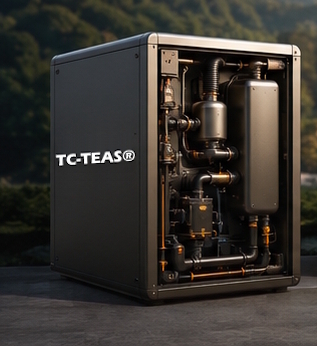
The experimental platform integrates energy units developed using TEAS® technology.
The R&D program uses TC-TEAS® modules designed to operate in integration with the thermo-active building structure and with distributed energy storage systems.
The TC-TEAS® units are designed to enable:
- modular electric thermal generation,
- distributed energy distribution,
- integration with thermo-active walls and chambers,
- multi-zone intelligent control,
- decentralized operation,
- modular architectural adaptability.
Within the TGT R&D experimental program, the platform contributes to the study of advanced building–system integration models aimed at:
- distributed thermal storage,
- enhancement of building thermal inertia,
- optimization of energy distribution,
- reduction of passive losses,
- intelligent modular energy management.
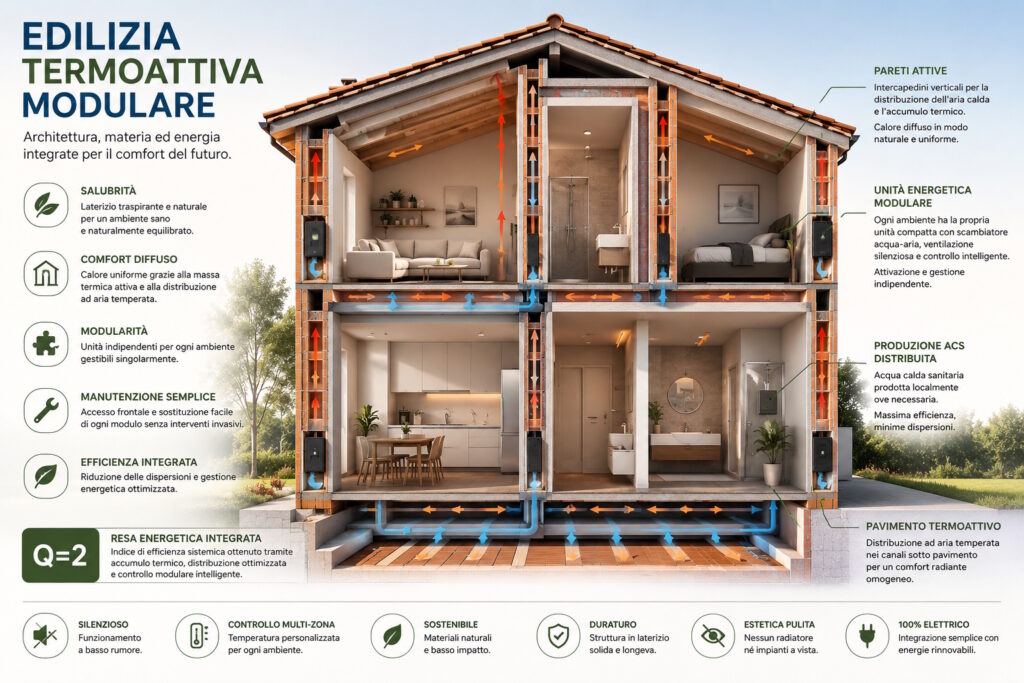
The internal experimental parameter “Q = 2” represents a theoretical research index used in the study of integrated building–system energy efficiency.
A dedicated section will further explore the architecture, operation, and applications of the TC-TEAS® platform.
Decentralized Energy Modularity
One of the main areas of development concerns distributed modular energy architecture.
Each space can integrate its own compact, independent energy unit, configurable according to the building’s functional requirements.
Local units may integrate:
- TC-TEAS® technology,
- air-to-water heat exchange,
- silent modulated ventilation,
- air filtration,
- multi-zone intelligent control.
Decentralization enables:
- adaptive energy management,
- selective activation of spaces,
- localized maintenance,
- high architectural scalability,
- integration with modular and prefabricated construction.
Integrated Thermal Distribution
thermally active walls,
The vertical cavities integrated into the structure allow:
- gradual distribution of thermal energy,
- controlled convective flows,
- discreet system integration,
- uniformity of surface temperatures,
- collaboration between building mass and energy distribution.
thermally active flooring
Distribution through underfloor technical chambers contributes to:
- improving perceived radiant comfort,
- reducing thermal stratification,
- increasing the indoor environment’s energy stability,
- promoting continuity of energy distribution.
System Energy Philosophy
The TGT R&D research activity is focused on building models characterized by:
- systemic energy efficiency,
- distributed energy inertia,
- thermo-hygrometric balance,
- reduction of passive losses,
- functional modularity,
- architectural integration,
- simplified system design,
- structural durability.
The research considers the building as a dynamic system in which structure, energy, environment, and thermal behavior operate in an integrated manner.
The objective is not solely to produce energy, but to manage it through the collaboration between building mass, energy distribution, and thermo-environmental stabilization.
Applied Research
The TGT R&D program includes activities in:
- thermo-fluid dynamic simulation,
- study of distributed energy inertia,
- Development of thermo-active bricks,
- Experimental testing on controlled convective diffusion,
- Thermo-hygrometric monitoring,
- Optimization of TC-TEAS® modular systems,
- Building–system integration,
- Development of decentralized energy architectures.
The research activities are focused on the development of evolutionary modular building platforms with high energy integration.
TGT R&D Research Areas
The development activities focus on:
- Thermo-active building systems,
- Modular technical bricks,
- Advanced wall breathability,
- Decentralized energy architectures,
- Integrated energy diffusion,
- intelligent thermo-hygrometric control,
- distributed thermal storage,
- High thermal inertia construction,
- Integration with TC-TEAS® systems,
- Evolutionary modular building platforms.
The goal is to contribute to the development of a new generation of buildings that are more stable, more efficient, and designed for long-term residential comfort.
Vision
TGT R&D envisions buildings in which:
- The architectural structure actively collaborates with energy,
- Comfort derives from the balance of building materials,
- Thermal mass becomes an active part of energy management,
- Bricks evolve into advanced technological components,
- Systems become modular, discreet, and distributed,
- Architecture and energy converge into a single integrated system.
A new thermo-active building approach focused on technical sustainability, structural durability, and long-term residential well-being.
Have Any Project?
Let’s talk and grow your business
We’re ready to help you. Our expert is here for you: send us a message

