Self-dissociation of water under strong electric fields: a paradigm shift for electrolysis and hydrogen.
Hydrogen is today one of the central energy carriers in the transition to low-emission systems. However, the actual efficiency of production processes—particularly via electrolysis—depends substantially on understanding the molecular phenomena that occur in water when it is subjected to intense electric fields.
A recent study by the Max Planck Institute for Polymer Research and the University of Cambridge, published in the Journal of the American Chemical Society, provides new insights into the behavior of water under strong electric fields, typical of advanced electrochemical devices.
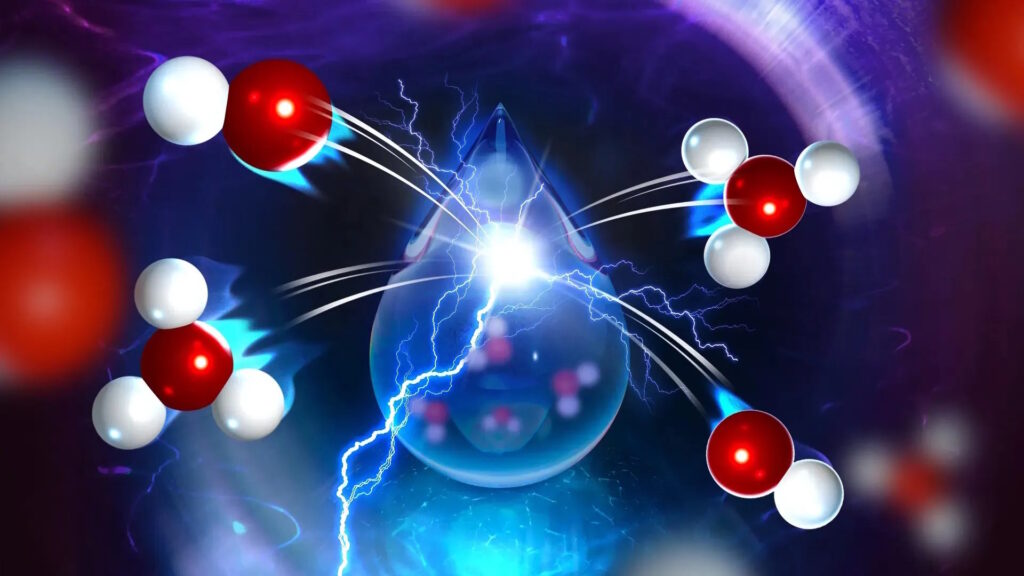
The central topic is the self-dissociation of water, that is, the spontaneous process:
H2O ⇌ H⁺ + OH⁻
Under standard conditions, this reaction is strongly disfavored both energetically (enthalpically) and entropically. But the picture changes radically in the presence of high electric fields.
What happens to water under a strong electric field?
Through advanced molecular dynamics simulations, the researchers observed a counterintuitive mechanism:
- The electric field induces strong molecular ordering.
Water molecules align along the direction of the field, reducing the structural disorder of the system. - The formation of ions disrupts this ordered structure.
When an H⁺/OH⁻ pair is generated, the enforced organization collapses locally. - The increase in entropy becomes the driver of the reaction.
The breakdown of order produces an entropic gain sufficient to offset the energetic cost of dissociation.
In other words, under a strong electric field, the process is no longer dominated by free energy in the classical sense, but by the entropic contribution associated with the destruction of a highly ordered configuration.
This represents a true paradigm shift compared to the traditional view of reactions in aqueous solutions.
Implications for pH and electrochemical systems
One of the most significant aspects concerns the change in acidity. Simulations indicate that, in the presence of intense electric fields, water can experience a substantial decrease in pH—from around 7 to values close to 3.
This phenomenon has direct implications for:
- Design of electrolyzers
- Stability and selection of materials
- Development of catalysts
- Modeling of electrochemical kinetics
- Management of corrosion and local ion concentration gradients
In real devices, where local electric fields can reach very high intensities (especially near the electrodes), ignoring these effects can lead to incomplete models or underestimation of critical phenomena.
Impact on hydrogen production
If entropy becomes a determining factor in the dissociation of water under an electric field, then the optimization of hydrogen production systems cannot be limited to energy balance alone.
It is necessary to consider:
- Field-induced molecular structuring
- Nonlinear effects at the microscopic level
- Coupling between the electric field and proton dynamics
- Local changes in pH and dielectric properties
This opens new perspectives in the design of:
- High-efficiency electrolyzers
- Systems with modulated or controlled fields
- Electrode architectures with geometries designed to maximize controlled structural effects
Towards a new engineering of fields applied to water
Research suggests that the molecular physics of water under intense electric fields is a strategic element for the advancement of clean energy technologies.
It is not just about supplying energy to split the molecule, but about understanding how the field:
- reorganizes the structure of water,
- modifies the entropic landscape of the system,
- alters the local chemical and physical conditions.
Integrating these aspects into models and devices represents a crucial step toward more efficient and predictable electrochemical systems.
Scientific reference
Further details available on ScienceDaily:
https://www.sciencedaily.com/releases/2026/01/260131084129.htm
Understanding the behavior of water at the molecular level under extreme conditions is not just a theoretical exercise: it is a concrete technological lever to improve the performance of hydrogen production systems and accelerate innovation in the sustainable energy sector.