Coherent “organized” water and incoherent “disorganized” water
Life on Earth originated in the oceans, and in the same way, every human being begins their development immersed in amniotic fluid composed of over 99% water.
Water is therefore an intrinsic element of life: it makes up the majority of our bodies, enables fundamental biochemical processes, and represents an essential factor for survival. It is well known that humans can endure relatively long periods without food, but cannot survive without water.
Despite its apparent chemical simplicity, water continues to represent one of the most complex and fascinating physical systems studied by science. Its set of anomalous properties—thermal, electrical, structural, and dynamic—suggests that this element, which we have believed we understood for centuries, may possess characteristics that are still not fully comprehended.
Christian Manil & Laurent Lichtenstein
Molecular Structure and Organization of Water
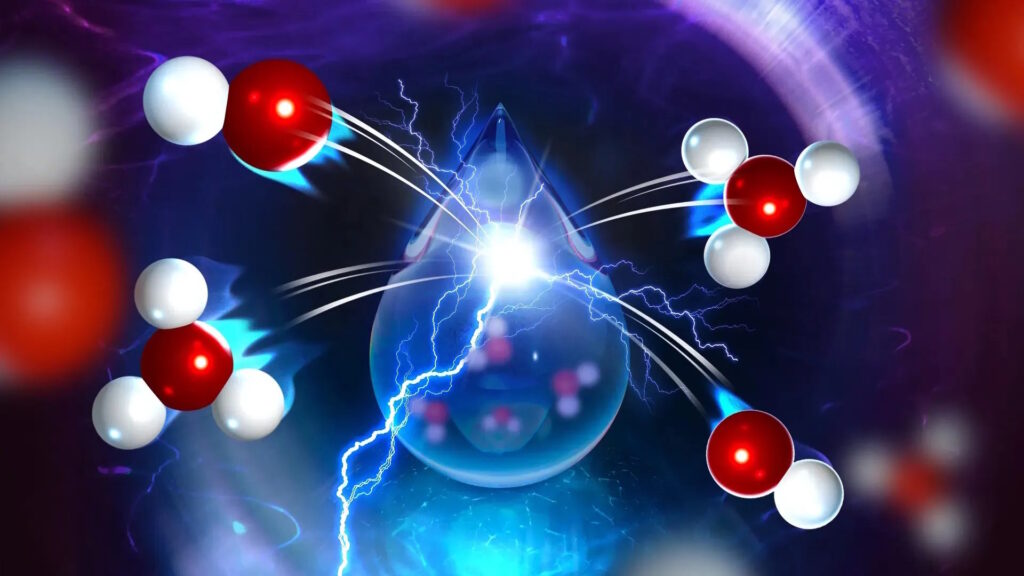
At the microscopic level, water does not behave as a simple, uniform liquid. H₂O molecules tend to organize into dynamic structures, connected by a network of hydrogen bonds that is constantly rearranging.
Depending on physical and energetic conditions (electromagnetic fields, contact surfaces, temperature, purity), water can exhibit different states of molecular organization.
In the scientific context, a distinction is often made between:
- incoherent or “disorganized” water, characterized by a random and highly dynamic molecular structure;
- coherent or “organized” water, in which the molecules exhibit a higher degree of spatial and energetic correlation.
These structural differences can significantly influence the physical properties of water, such as conductivity, electrochemical behavior, and interaction with electric and electromagnetic fields.
The Quantum Coherence of Water: Contributions by Preparata and Del Giudice
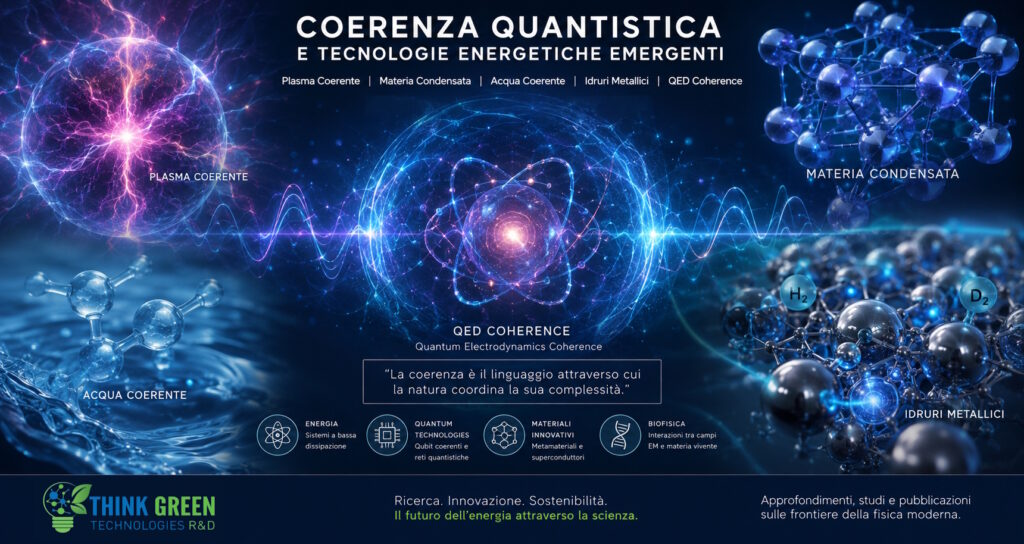
A fundamental theoretical contribution to the understanding of coherent water was provided by physicists Giuliano Preparata and Emilio Del Giudice, who developed a model based on quantum field theory (QFT) applied to condensed systems.
According to this approach, under certain conditions water can organize into coherence domains—spatial regions in which a large number of molecules oscillate coherently, synchronously, and in correlation with an internal electromagnetic field.
Within these domains:
- the water molecules share a collective quantum state;
- energy is partially stored in an ordered form;
- physical properties emerge that differ from the surrounding incoherent water.
The Preparata and Del Giudice model suggests that these coherence domains may play a significant role in biological systems, facilitating energy transfer, molecular communication, and the organization of living matter.
Water and Complex Biological Systems
In biological systems, water does not act solely as a passive solvent. It actively participates in the organization and stability of cellular structures, interacting with membranes, proteins, and nucleic acids.
The presence of coherent water regions could contribute to the regulation of biochemical and biophysical processes, providing an interpretative key for phenomena that cannot be fully explained by classical models based solely on random interactions.
EZ Water and Contemporary Research
In line with these theoretical studies, the experimental research of Dr. Gerald H. Pollack has highlighted the existence of so-called EZ water (Exclusion Zone).
Near hydrophilic surfaces, water can organize into a distinct phase, characterized by:
- a high degree of molecular order,
- electric charge separation,
- physical and electrical properties different from bulk water,
- behavior comparable to a reversed electrical polarization.
Although developed using different approaches, the experimental observations on EZ water are consistent with the idea that water can adopt stable organized states under specific environmental and energetic conditions.
Multimedia Insights
To complement this overview, a video contribution by Dr. Gerald Pollack is available, focusing on EZ water and its electro-physical behaviors.
The video includes subtitles and can also be translated into Italian, facilitating the dissemination of these cutting-edge topics.