The possible new evolution of the hydrogen engine.
A new generation of hydrogen internal combustion engines could radically change the very concept of internal combustion.
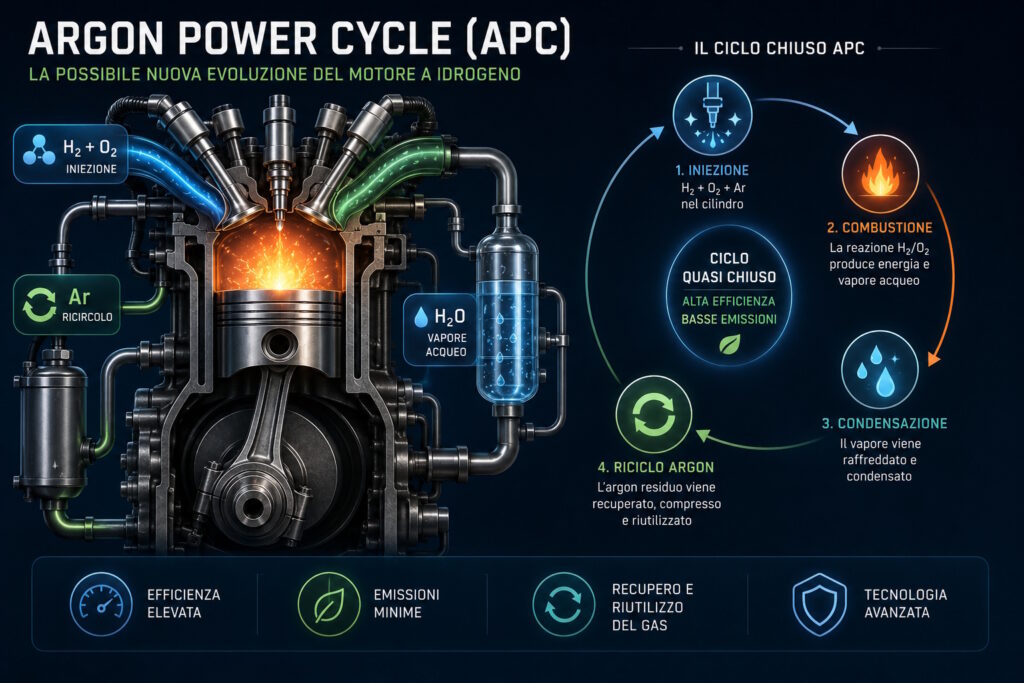
Argon Power Cycle (APC) engines use hydrogen, pure oxygen, and argon in a near-closed-loop system designed to recover part of the working fluid and increase the engine’s thermal efficiency.
Unlike traditional open-exhaust engines, the APC cycle aims to:
- recover and reuse argon,
- condense the water vapor produced by combustion,
- drastically reduce local emissions,
- improve the theoretical efficiency of the thermodynamic cycle.
In recent years, universities and research centers in Germany, Japan, and China have published experimental studies on APC engines capable of achieving very high efficiencies under laboratory conditions.
Although this technology is still in the experimental stage, many researchers consider the Argon Power Cycle one of the most advanced theoretical evolutions of the conventional heat engine.
A new concept of a heat engine.
For over a hundred years, the internal combustion engine has dominated the world of transportation and industry. Today, as the energy transition accelerates toward low-emission solutions, universities and research centers are exploring new pathways to drastically increase the efficiency of heat engines.
Unlike traditional gasoline or diesel engines, APCs do not use atmospheric air in the conventional way.
The system employs:
- hydrogen as a fuel,
- pure oxygen for combustion,
- argon as a working gas to be recovered and reused.
The most important difference is that the cycle does not operate as an “open exhaust” system like traditional engines. A significant portion of the gases is instead recovered, cooled, and reintroduced into the system.
For this reason, it is referred to as:
- Closed-Cycle Hydrogen Engine
- or Argon Power Cycle.
The German project that has attracted international attention
In 2026, a research group at Otto von Guericke University Magdeburg in Germany presented an experimental prototype capable of exceeding 60% indicated thermal efficiency in laboratory conditions.
According to the project:
- the engine uses hydrogen and pure oxygen,
- the water produced by combustion is condensed,
- the argon is recovered and reused,
- the system operates with almost no external exhaust.
The project was developed with the support of WTZ Roßlau gGmbH and the German Federal Ministry for Economic Affairs and Energy.
Source:
https://www.motorcycles.news/en/hydrogen-closed-cycle-engine-magdeburg-efficiency/
Why is argon so important?
One of the most original aspects of this technology is the use of argon.
Argon is a noble gas naturally present in the Earth’s atmosphere and has highly favorable thermal properties for this type of application.
According to researchers, argon would allow:
- improve the theoretical efficiency of the engine,
- reduce certain energy losses,
- facilitate the operation of the semi-closed cycle.
Argon also has a high specific heat ratio, a characteristic that can increase the theoretical efficiency of the thermodynamic cycle compared to conventional engines.
The theoretical efficiency equation of the Otto cycle is:
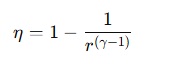
where:
- ( r ) represents the compression ratio,
- ( γ ) represents the specific heat ratio of the working gas.
By using pure oxygen instead of atmospheric air, the system also drastically reduces the formation of NOx, one of the main pollutants produced by traditional engines.
How an APC engine works
The operating principle is relatively simple.
1. Injection
The engine is supplied with:
- hydrogen,
- oxygen,
- recirculated argon.
2. Combustion
The reaction produces thermal energy and high-temperature water vapor.
3. Condensation
The vapor is cooled and condensed.
4. Argon recovery
The remaining argon is recovered, compressed, and reused in the next cycle.
In practice, the engine aims to recover and reuse part of the working fluid instead of fully exhausting it to the outside.
A research effort involving multiple countries.
Germany is not the only country working on this technology.
Japanese and Chinese universities are also developing advanced APC systems.
Tokai University (Japan)
The Japanese research group at Tokai University has been studying for years:
- closed-cycle hydrogen engines,
- combustion with argon,
- detonation issues,
- increase in thermal efficiency.
Tongji University (China)
Tongji University is instead working on:
- anti-knock strategies,
- water injection,
- cycle optimization,
- theoretical efficiencies above 70%.
These values remain experimental and obtained under laboratory conditions, but they demonstrate the growing international interest in this technology.
High efficiency, but also great complexity.
APC engines promise efficiencies normally associated with:
- fuel cell,
- large industrial turbines,
- advanced power plants.
However, there are still many technical issues to be solved.
Among the main ones:
- system complexity,
- hydrogen management,
- high-temperature control,
- high costs,
- industrialization challenges.
The energy limitations of the entire system
When discussing the efficiency of APC engines, it is important to distinguish between engine efficiency and the overall efficiency of the energy supply chain.
| Process | Typical efficiency |
|---|---|
| Electrolysis | 65–80% |
| H₂ Compression | |
| APC Engine | 55–70% Theoretical |
The final efficiency therefore also depends on:
- hydrogen production,
- compression and storage,
- pure oxygen production,
- heat recovery,
- system energy management.
For this reason, many experts believe that APCs may be better suited to:
- stationary generators,
- industrial plants,
- maritime sector,
- specialized energy systems.
Much more difficult, however, appears their use in:
- city car,
- motorcycles,
- mass-market automotive.
Why this technology is of interest today
The growing interest in APC engines is linked to the search for new solutions for the energy transition.
In recent years, investments have increased in:
- green hydrogen,
- energy storage,
- high-efficiency systems,
- low-emission technologies.
In this context, Argon Power Cycles represent an attempt to rethink the internal combustion engine by using thermodynamic principles that are more advanced than those of traditional systems.
A possible new frontier for the thermal engine
Today, APCs remain an experimental technology, still far from large-scale production.
However, the growing number of scientific publications and the results achieved by international research groups show that this field is attracting increasing attention.
The real innovation is not simply “burning hydrogen,” but transforming the thermal engine into a system capable of recovering and reusing part of the energy that is normally wasted.
If fuel cells represent the electrochemical evolution of energy, Argon Power Cycles could represent one of the most advanced theoretical evolutions of the conventional thermal engine.
References and publications
Otto von Guericke University Magdeburg
https://www.motorcycles.news/en/hydrogen-closed-cycle-engine-magdeburg-efficiency/
Tokai University
https://cir.nii.ac.jp/crid/1390573242713910656
Tongji University
https://www.mdpi.com/2227-9717/11/6/1850
https://www.sciencedirect.com/science/article/abs/pii/S0360319925057684